Some deliveries may take a little longer than usual due to regional shipping conditions.

DOWNLOAD THE APP


Customer Services
Copyright © 2025 Desertcart Holdings Limited
DOWNLOAD THE APP
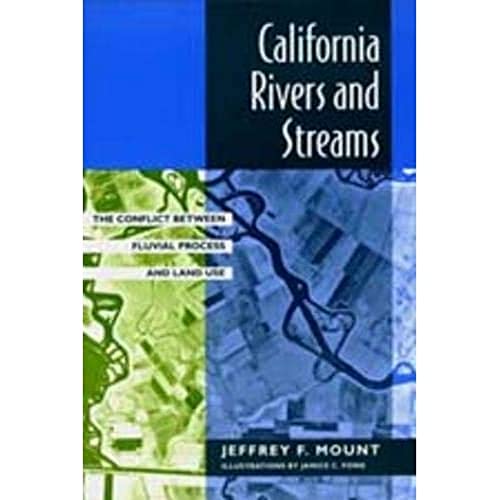
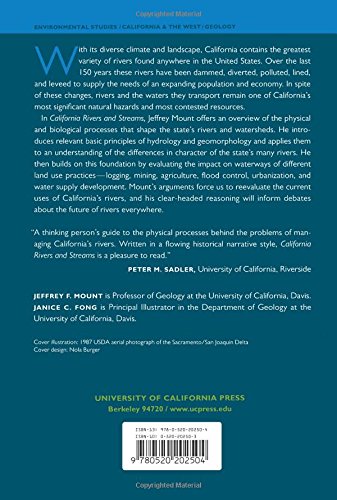
California Rivers and Streams: The Conflict Between Fluvial Process and Land Use
T**K
Four Stars
useful information
C**T
Good coverage of many controversies.
Good coverage with helpful history. Overall pessimistic conclusions are provided with ample justification by this book.
K**D
Hydrology text
Although the examples are from California streams, the lessons are relevant to any who wishes a deeper understanding of riverine processes.
F**R
revew of CA rivers and streems book
This book arrived in a timely manor and everything was as it was supposed to be.
R**R
Excellent Comprehensive Book on California Rivers
California Rivers and Streams: the conflict between fluvial processes and land use, Dr. Jeffrey F. Mount, 1995, University of California Press, 359 pages California geologists, engineers, environmental planners, and the general public will enjoy reading this comprehensive book on California rivers. The author is Dr. Jeffrey Mount, who holds the Roy J. Shlemon Chair of Geology at the University of California, Davis. Dr. Mount is the Director of the Center for Watershed Sciences at UC Davis. He has formerly served on the Reclamation Board within the California Resources Agency. With a heightened sense of public concern about flooding, water supply, levee repair, fish habitat, and river restoration, this book on California rivers is the best general primer that is currently available. Although not designed as a textbook, California teachers may find it suitable for introductory courses because of its comprehensive scope and highly readable narrative. The book is divided into two parts. Part 1, How Rivers Work, includes: Chapter 1, Introduction to the rivers of California; Chapter 2, Water in motion, Chapter 3, A river at work ¯ sediment entrainment, transport, and deposition; Chapter 4, The shape of a river; Chapter 5, Origins of river discharge; Chapter 6, Sediment supply; Chapter 7, River network and profile; Chapter 8, Climate and the rivers of California; Chapter 9, Tectonics and geology of California's rivers. Part 2, Learning the Lessons: Land Use and the Rivers of California, includes: Chapter 10, Rivers of California ¯ the last 200 years; Chapter 11, Mining and the rivers of California; Chapter 12, Logging California's watersheds; Chapter 13, Food production and the rivers of California; Chapter 14, A primer on flood frequency ¯ how much and how often? Chapter 15, The urbanization of California's rivers; Chapter 16, The damming of California's rivers; and Chapter 17, The future ¯ changing climate, changing rivers.Review by Robert H. SydnorCalifornia Certified Hydrogeologist #6LM-AEG, LM-AAAS, LM-AGU, M-GSA, M-AGWA
J**K
Heated Debates about the Future of CA's Watersheds
I can do no better than the hydrogeologist Syndnor in summarizing the utility of this introductory work. My only critique is that Mount needs to revise the chapter on climate and consider projected impacts on CA's surface water based on what we now know after 13 years of data collection.Just as Knox needs to revise his primer Global Climate Change and California (1992).
P**8
Best book for anyone living near or any way connected to H20
This book will answer any questions you have and then answer all the questions you are too dense to think of. Anyone living in California should be forced to read this. River runners also benefit from this book that shows the correct fleuvial processes, unlike many kayaking/rafting books. Read it, get on the water and then fight for the rivers!
Trustpilot
3 weeks ago
3 weeks ago
1 month ago
2 weeks ago